

My Labrador Still Won’t Stop Pulling!
You have tried everything. Walking up and down, round in circles, standing still, food, toys.
Nothing works.
Your Labrador is still dragging you along in his wake, oblivious to the fact that he is choking and strangling himself in the process.
If you have a confirmed ‘puller’ and you are just sick of it.
This article is for you.
Why do Labradors pull?
You would think that it must feel horrible dragging a person behind you all the time, with your collar cutting into your throat. So why do dogs do it?
Dogs pull because they are constantly rewarded for pulling. Many, many dog owners reward their dogs for pulling.
This isn’t their fault, it is to do with the way we exercise our dogs.
But unfortunately, until we stop dishing out the rewards, the pulling will continue.
“But no!” you say “I don’t reward my dog for pulling”. Well actually you do, or at least sometimes you do.
Pulling dogs reward themselves
The best reward in the world for your dog is to be out and about. Especially to go somewhere fun, like the fields or the woods.
And if you walk him to these amazing places on a lead, let him pull you there, then top it all by letting him run free, as far as your dog is concerned, dragging you along just got him the best reward in the whole world.
And of course behaviour that is rewarded, is reinforced – it is more likely to happen again.
One way to avoid this scenario developing is to drive the dog to his exercise location until his lead training is complete. But of course, not everyone is in a position to do that.
Exercise is such a powerful reward, anything which precedes it is reinforced. This means that when you walk a dog to his exercise area on a daily basis. He soon believes that dragging you behind him actually results in a walk. And he is kind of right, isn’t he?
What can you do to stop your Labrador pulling on the leash?
There is no doubt that pulling is a behaviour that can be cured. A professional trainer can cure it, and if you use an effective method, you can cure it too.
Whether you really want to go through the curing process, or are prepared to do so, is another matter.
Different approaches to stopping your Labrador pulling on the leash
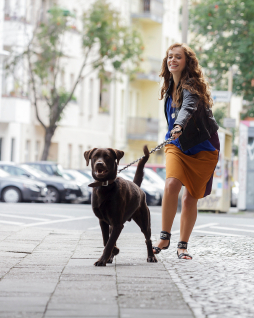 There are two very different approaches to dealing with a dog that has already learnt to pull strongly on the lead.
- Aversive based
- Non-aversive based.
People get very confused over which is best. And when they fail, they often blame the method. Actually, both methods work provided that you follow the same principles
- Stop all rewards for pulling
- Establish your nice loose-lead walk at home
- Add distance and distractions in achievable stages
Stop the rewards
It is crucial to note that both aversive and non-aversive methods require that you completely stop rewarding the dog for pulling. Neither will work if you keep on rewarding him for bad behaviour. The power of the reward of exercise is too strong and most dogs will put up with a lot of punishment in order to get that reward.
The problem is, that stopping the rewards entails either driving the dog to an exercise area, or temporarily limiting his exercise to as many steps as he can manage in the correct heel position.
And at first this will be very few steps indeed.
Many people have a big problem with this.
They fight against the inevitable, which is that if they keep rewarding the pulling, the pulling will continue. Not to mention the fact that effective training takes time!
The more training sessions you can fit into each day, the sooner you will be able to build up distances, but this requires a lot of input on the part of the owner. And it is not easy to fit multiple training sessions into our busy lives.
How hard is it to stop your Labrador pulling?
People get desperate because the whole process of change seems to take forever. And of course the longer the dog has been pulling for, the longer it will probably take to break the habit?
So is it really worth trying?
Deciding if stopping your Lab pulling is worth the trouble
Perhaps the most important question you need to answer, is this one:
Is the benefit of having a dog that walks nicely on the lead, really worth the trouble of implementing the cure?
Unfortunately, only you can decide what the answer is. Your situation is unique to you, and only you know how much time and energy you have to pour into dog training. Before you can make that decision, you really do need to know honestly, what is involved.
Fortunately there are no really hopeless cases. Virtually all dogs can be taught to walk to heel. But which methods work best, and how long will it take?
Choosing how to stop your Lab pulling
Most of the articles on this website are non-aversive based for many reasons. However, heelwork is one area where some people do better and achieve quicker results, using aversives.
Let’s look at non-aversive methods first and see why some people succeed and some people fail.
Non-aversive methods of stopping Labs pulling
All non-aversive methods use the same principle. The dog is trained through rewarding the ‘slack lead’. Usually a reward marker (like a clicker) is used and initially the owner ‘marks’ any reduction in tension on the lead, or any attention the dog pays to the handler, no matter how brief.
Once the handler has the dog’s attention he can be encouraged into the heel position.
Some people use a ‘lure’ to hold the dog into position, but this is optional. The point is, that the dog straining at the end of the leash has to relax at some point. And at this point the owner can give the marker, and reward the dog, bringing him into position as he does so.
This method requires patience, but most people manage to get the basic heel position and a few steps at heel established in a quiet and distraction free area, such as their kitchen or back garden.
Why can’t I stop my Lab pulling?
Problems arise with non-aversive training because the dog owner misses out the most vital part of the training process and then rapidly starts rewarding the pulling again.
Often the owner will succeed in achieving some nice lead walking at home. They then attempt to duplicate the nice lead walking that they have established in their garden, over long walks and or in highly distracting environments, where everything promptly falls apart.
Many people are simply unaware that each skill we teach a dog at home, has to be proofed effectively in order for the dog to understand that the command he has been given applies in different locations and under different conditions
Training your Labrador to stop pulling
Proofing is a hugely important part of any dog training programme and is frequently ignored. The lack of understanding about the proofing process is at the heart of many if not most dog training failures. If you are struggling with any aspect of dog training, the chances are you have not got to grips with proofing.
With heelwork, if the dog’s new lead training is not proofed and he is then taken for a walk in public, there is only one possible result. The dog will start to pull again, and the owner will be back to where he was before he started training.
Rewarding again
The second reason that people fail using this technique is that they never really commit to stopping rewarding the dog for pulling. Remember, free running is a fantastic reward. But any kind of exercise, even on the lead, is also rewarding to the dog. Just moving forwards is rewarding. And so is the very act of pulling in itself.
There is no point rewarding the dog for not pulling and rewarding him for pulling, all at the same time. You won’t make any progress at all. You have to commit to permitting no more rewards for pulling. In other words pulling from now, from today, has to get the dog nowhere. Not a single inch. And this can be a real challenge for many of us.
When training doesn’t work
People say ‘I have tried that and it didn’t work, he still pulls’
But it isn’t strictly true.
At some point the owner ‘gave up’ and allowed the dog to move forwards. At some point they made a decision that ‘enough is enough’ and they would rather be dragged than wait any longer.
Rather than “It doesn’t work” the truth is that for some people the method simply takes too long. They don’t have the will to see it through until the end.
This is not a criticism.
It is perfectly understandable, there is more to life than training your way out of this difficult and drawn out problem, and tackling it head on is not for everyone.
But I think it is important to be honest about where the fault lies. The fact is, the method does work, and it works every time provided you don’t give in.
If you are going to give in, then at least be aware that you have made a choice to do so. It is OK for you to say “I don’t want to do this any more”
On the other hand, it is good to know, that if you persist, you will prevail.
Making Labrador training work
The secret to nice lead walking is to master two steps. Two perfect steps, and then build on them, adding distance and distraction in tiny stages. And never allow pulling to result in any kind of forward movement for the dog.
It is also important to know that if things fall apart it is not because your dog is untrainable or because you are incompetent, it is because you have either made too big a jump in your training (proofing errors) or slipped back into the habit of rewarding the dog for pulling (allowing him to pull you at all). Both of these errors can be fixed!
Let’s have a look at some common triggers for the pulling to recur. These are errors in proofing.
Common errors in Labrador training
The most common error is huge leaps in distance. The dog learns to walk two steps at heel, and the owner thinks he has ‘cracked it’ and sets off for a 300 yard expedition. Within two minutes his training has collapsed. He is gutted, the dog is confused, and the pulling starts all over again.
Another common error is the introduction of distractions in situations you cannot control.
You can’t expect your newly heel trained dog to walk to heel past another dog in the park or on the pavement if you have not trained for this at home with a friend or at your local dog training club.
This can be frustrating for the new dog owner. They want to get results quickly, they think that the dog understands their command and they believe that the dog should obey them, no matter where that command is given.
But dogs don’t work quite like that. They don’t generalise well, and are often bemused to find that the command ‘heel’ is meant to apply on beach or in town, or after twenty paces of walking nicely.
It takes time for dogs to learn to cope with increasing duration of an activity or with these kinds of distractions. And they need to be taught how to do so in controlled situations.
How to succeed without aversives
The proofing process for heelwork (or any other skill), especially when using aversive free training, needs to be done in very small steps to ensure success at every stage. Proofing is simply the introduction of distractions or increasing levels of difficulty
There is a series of articles which will help you to work through this process in structured steps. This kind of training takes time, especially with a confirmed ‘puller’ and you will need to be patient.
If you have failed with this kind of approach in the past, you will need to go back to a point or place in your training when you were succeeding. And move forward in smaller stages from there.
There is a also a good description of non-aversive heel training in this book My Dog Pulls, by Turid Rugaas. I have written a review of this book which comes out next Sunday. There are also some good videos on the Kikopup and Tab youtube video channels where you can see these techniques in action.
But I need to get from A to B!
“It’s all very well” you say, “but I don’t have all day to wait for my dog to turn around and look at me. I need to get somewhere!”
And of course you do. We all lead busy lives. Training your dog is just one small part of your daily responsibilities.
“So is there another, quicker, way?”
Well, yes there is. Though many modern dog trainers no longer like to use them, aversives can be used to achieve fairly rapid effects with a dog that pulls on the lead.
A competent trainer can stop a dog pulling under normal circumstances in a very few sessions. Though this won’t help his owner unless they learn the techniques too, and apply them with absolute consistency.
So why are we not teaching or recommending these methods?? Let’s have a look.
Heelwork through aversives
The principle of aversive based heelwork is to correct the dog for leaving the heel position. He is corrected effectively by pulling him sideways as a dog has little strength to resist a sideways pull and is easily unbalanced.
Pulling a dog backwards is far less effective as a dog’s musculature is built to enable him to pull strongly in a forwards direction. As you have probably discovered, your dog can happily drag a nine stone person around behind him all day long.
Pulling backwards may also put a lot of pressure on the soft tissues of the dog’s throat and in theory could cause permanent damage.
Even though the dog seems not to care.
The problem with this more traditional approach is that the dogs that most need help, are often the strongest and most determined.
Which means that considerable skill and some force, is needed to ‘unbalance’ the dog and stop him from pulling.
Because pulling on a dog’s neck is potentially harmful, and because aversive heelwork techniques must be applied in an appropriate direction (ie sideways not backwards) and with an appropriate amount of force in order not to harm the dog, they are best demonstrated by a skilled trainer.
But the catch 22 is that many skilled trainers no longer use these methods. Of those trainers that do use aversives for heelwork, some are still using potentially harmful techniques or hugely disproportionate amounts of force. I have read reports of dogs being treated for ‘whiplash’ after being poorly handled in this way by a supposedly very experienced trainer.
For this reason I recommend that novice dog owners that want to use aversive heelwork techniques, are taught by a professional and reputable trainer that comes personally recommended to them by a knowledgeable friend.
If you cannot find such a trainer, you really are better off using non-aversive methods like those outlined in the link above.
And remember, that even with aversive methods, your heelwork will break down in the presence of distractions you have not trained for. You may be able to take slightly bigger steps in your proofing process but you cannot eliminate it altogether. The dog will simply forget his training if you try to press on too quickly and you will be left struggling with him in public.
Triggers for pulling on the leash
Whatever method you finally settle on, there are steps you can take to help yourself progress more quickly.
There are certain ‘triggers’ in a dog’s environment that can produce startling and sudden breakdowns in training of any description. Heelwork is no different. Part of getting good heelwork established lies in recognising those triggers and practicing for them.
Many dogs for example like to charge through doorways or gateways or in and out of vehicles. If your dog is at heel. Always make him sit just before you reach a ‘trigger point’. The sit allows you to gather yourself and focus on the dog. And breaks his ‘forward motion’ enabling him to become calmer and more collected.
Controlled introduction of distractions will benefit you enormously. Get a friend with a dog to come into your garden and practice walking the dogs past one another at home where you have more control. If you cannot get this right here, you stand no chance of getting it right in public.
Set up as many practice situations as you can. Heel your dog past food, people, other dogs, anything you think might tempt him to break his position, all at home in your garden. Remember proofing cannot be skipped, no matter which methods you choose, and it is so much easier to do it, if you get the process started at home.
Working out why your dog is still pulling on the leash
If your dog has not responded to your training methods so far you need to take a step back to a point where he was getting it right.
Establish a ‘base station’ from which to progress. Was there a place or a time when he was able to walk at heel for just two steps? Go back to that time. To those first two steps. To a single step if necessary. Get it right, then build on it. Commit to never rewarding pulling again.
Positive training for heelwork
With a confirmed puller, if you are struggling to get those first two steps established at home, you may find it helps to take a slightly different approach. The lead itself is often a trigger for the dog to pull. One way around this is to teach a clicker heel with the dog free and off the lead.
Do this at home in an enclosed area, then add a new, preferably quite different, lead once you have mastered heelwork with the dog loose. Again, you will need to ‘proof’ the new heelwork carefully.
There is no easy solution to curing a confirmed puller. These rules apply no matter what method you use. And applying them takes time.
But with persistence and patience you will win, and you will be rewarded with a dog that walks nicely at your side.
Good luck with your training
More information on Labradors
 (paid link)You can find out more about how to teach your Labrador to walk nicely in the Training section of our website.
If you’d like all of our best Labrador information together in one place, then get your copy of The Labrador Handbook today.
The Labrador Handbook looks at all aspects owning a Labrador, through daily care, to health and training at each stage of their life.
The Labrador Handbook is available(paid link) worldwide.


Free Labrador Updates!
Get my training tips, news, reviews, and the latest from The Labrador Site delivered to your inbox
The trouble is, I have a young high energy dog and she has to go for walks! We are constantly stopping and using these techniques but we can’t remove her reward of exercise when she needs exercise??
This is a good article except I feel like it doesn’t apply to me. I live in a large complex. There is no “perfect at home then venture out”. What is most people’s walk in the park is my walk around my home. There’s a dog park here, a couple stores, and many many people and dogs all in my back yard. Since my 10 month old was a puppy I’ve stopped her made her look at me then went on. We never get anywhere without more than 2 steps. When she pulls she doesn’t go to the park, doesn’t go to the area she wanted. She’s still not figured it out and I’ve not slacked on doing it. Now she’s so large me stopping her (she weighs only 40lbs less than me) requires all the energy and force I have. Today she pulled me out in front of a car and I couldn’t stop her. She’s pulled my mother down the steps. It’s almost like she has no idea why we are making her stop and look at us. I honestly don’t know what to do because I have tried this. And we’ve been working on it her entire life and it’s not working and now there’s almost no stopping her. I also bought a gentle leader and she pulled so hard she broke it.
My lab, whom we adopted as an adult older dog, pulls a lot while out on walks. His main attraction is food lying around on the road, often near the garbage pick up point or brought by people for stray dog. I am afraid he will hurt is neck some day. I will try the advice in this article, but how do I reduce his constant and desperate search for food? He eat a healthy meal at home with enough good quality treats in between meals, but behaves as if starved. Even at home, he is always ready to eat, even begging when someone has their medicine.
Pippa, you’re my new best friend.
First, I need to start off by saying I have a Golden Retriever, not a Lab, but I was at my wits end trying to get him to loose leash walk and I had almost given up hope. He’s a little over a year and 2 months now and knows so many tricks, has good manners, etc – but will not loose leash walk. I’m along for the ride when we go outside, so to speak. Anywho, we’ve taken many training classes and every time the trainers always try and help me with this issue, but it just doesn’t click for my dog, Archer. I’ve been through what felt like everything, Martingale collars, soft “choker” collars, turning around the second he pulls and walking in the other direction (I ended up just doing almost 360 turns, continuously), stopping until he stops pulling, treats at the hip, etc — but none of it worked.
Then…when I had pretty much given up, I googled one last time and came across your post. You said something in this post that I’ve never been told and that helped tremendously. We’ve been able to loose leash walk in the house for a long time, no problems, but the minute we take that “perfect walking” outside it’s like he forgot everything. The thing you said was basically..don’t reward him. Now, when I first read that I was like..”I don’t anymore, because it doesn’t work anyway”. I never realized practicing loose leash walking while actually on a walk is rewarding him. I’d take him for a regular walk, long enough to satisfy his exercise need at the time, while practicing loose leash walking and it’s always been a nightmare. So, I changed my angle and started practicing when I took him “outside” to go to the bathroom. I was determined even if it took us 10 minutes to make that 20 foot walk to his spot, I would not move unless he loosened the leash, I wouldn’t even accept the slightest bit of tension that felt like he was “leading”. Not only that, but when I take him to the park, I drive him there and before he’s even out of the car, I’ve already got him on his 75ft lead, so he can hop out of the car for his “free run” and not think we’re practicing as we get into the park. Well it took quite a while the first time, whenever I start walks I always say “Let’s Go” and he knows that means we’re going for a walk, but I started every time he was pulling the leash too much, waiting for a bit of slack, then saying “stay with me” and I’d start walking again. That was three days ago and we’re still NOWHERE near perfect, but it’s like a night and day difference, he still gets excited and wants to string me along when he’s close to his spot, but I’ve even started making him loosen the leash when he’s walking on his grass patch, so we’re getting somewhere. I’m so proud of him, every time I say stay with me, he loosens back a little and gives me eye contact like, “alright, but can we go!!” 🙂
Not only that, but your article made it clear that I shouldn’t really be trying to teach him in heel position, that will come later and that was a huge help. It seems silly, but that was a detail that was overlooked when my trainers were trying to help me, so thank you.
This article has been a tremendous help and I can’t wait to keep practicing with him, I really think, it’ll be flawless in a couple of days. I do have a question for you, though!
Once he’s perfected loose leash walking, how would I transfer that to heel position walking? I’m considering taking Rally with him soon and I want to make sure he has that down before we start class.
Again, thank you so much for everything, you’re a life saver!
HELP NEEDED hi i have 2 male Labradors aged 4 and 6 the older ones walks perfectly fine on lead and is very obedient. the younger one is like a raving bull as soon as he sees the lead barking jumping non-stop. he pulls like mad and even pulled me and the other dog into a thorn bush. the older dog has been neutered is this the reason he is more obedient ive taught them both the same, but cant seem to get the younger male to walk loose lead.
hi. my 3 week old puppy pulls so hard to return back home. he hates so cranky to be peeing outside. I take him out and he pulls as hard as he can to go back up the steps. I stay still and hand on to the rope very hard. I am scared of hurting his neck so then I give in to his pulling and we go back in. how do I correct him from being stubborn about peeing outside and pulling back to the steps. he cries, barks so loud that I give in. help please.
Hi Maria, a three week old puppy should be with its mother and siblings, not on the end of a rope. Please read this article. I hope you can find a way to return your puppy until it is old enough for you to bring it home and start training. https://www.thelabradorsite.com/too-young-to-leave-mum/
Thanks for the great article. Our puppy is 3 months old, and walks really well right up until we turn to come home, and then starts pulling hard. You’re totally right….eventually we give up becuase we want to get home. I guess we need to schedule in some “stubbornness” time into our walks for a while so we can be consistent.
Thanks for reply
Piper has been to classes, she is normally very good but she has what I call her blonde days (she is cream).
She behaves like a complete idiot and it is normally when she sees dogs/people she hasn’t seen for a while. She then pulls for all she is worth trying to get to them and of course I try to keep her back.
Thankfully we don’t get to the collapsed stage very often, its just so frightening when it happens
My daughter has suggest a harness
Hi Heather, you need to train her to walk on a loose leash. If you are struggling to do this alone using books and articles like the one above, I suggest you contact your nearest APDT trainer and book some lessons to get you started. Best wishes, Pippa
thank you so much…I have two puppies each nine months old.
While walking pulls away suddenly when they find something exciting(colorful paper, toy).
What exactly I should do, when they pull me suddenly?
Hi Shree, you will need to train your dogs to walk on a loose lead. You will need to train each dog separately. You can find articles on how to do this in our Basic Obedience Training section. During the proofing process you will teach them to ‘heel’ past various distractions including things that your puppies find exciting. Until the training is complete, you may find it easier to have them on an ‘easy walk’ harness that helps to discourage pulling and gives you more control.
Pippa
Our lab/chow puppy is almost one. She is enormous and stubborn! Sometimes her walks are scheduled so there’s only a certain amount of time to excercise. You are totally right though, we haven’t succeeded because it’s not EVERY time. We’re going to try again. Thanks for a great article!
You are welcome, thanks for your kind comment and good luck with your training!
I can truly say that when I read this in your book I had a light bulb moment ! Lottie was only a young puppy but already thought full steam ahead was the only way to go, she soon stopped pulling when she realised that she no longer got to go in the field when she pulled, infact she got walked right past the field, now that she is no longer pulling she gets to enjoy her off leash time.
Glad you have ‘cracked it’ Julieann 🙂