

Crate Training Your Labrador Puppy
Every puppy I have crate trained has loved their cosy den. They voluntarily go there to sleep, chew a toy or simply have a little respite from the rest of the bustling household.
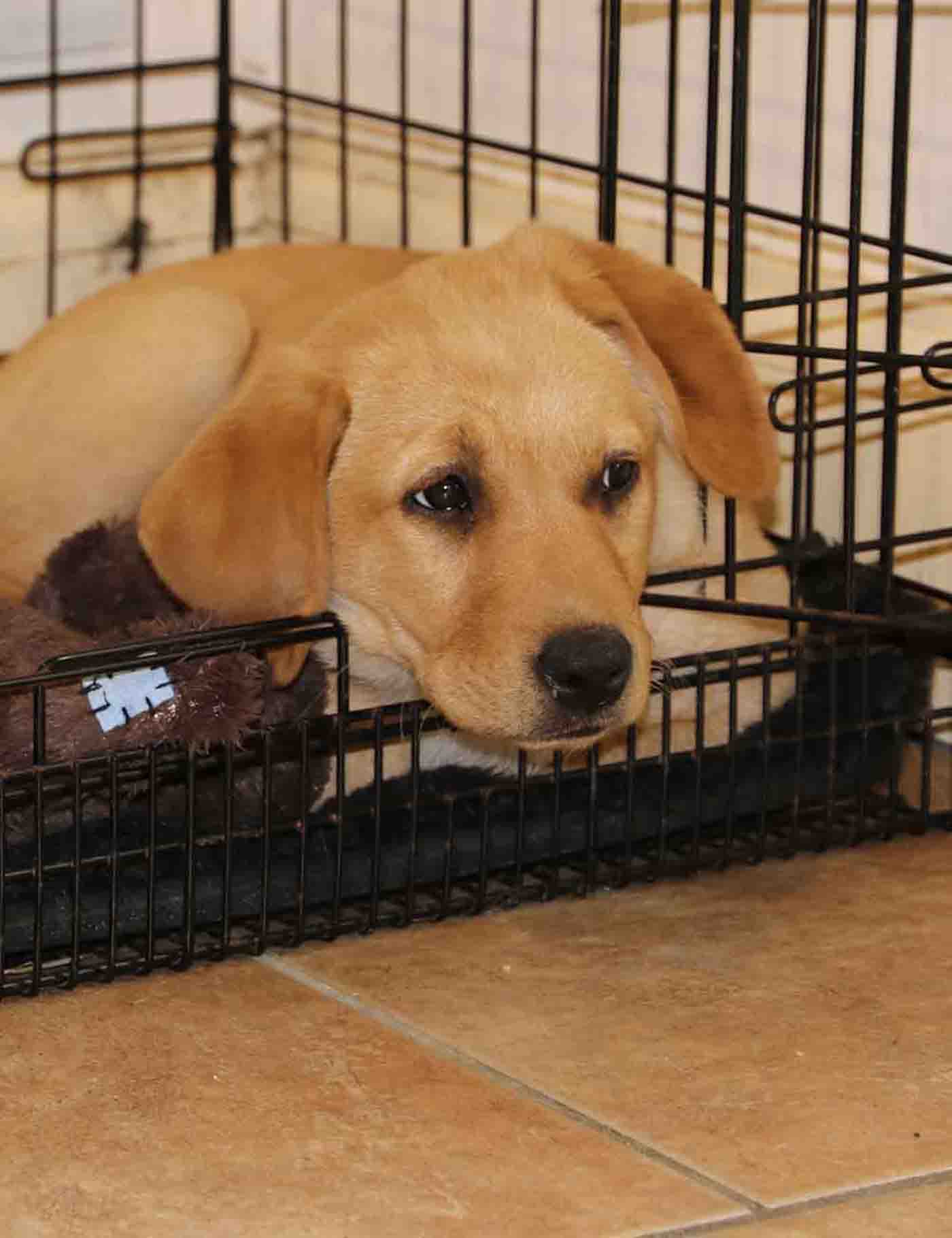
A crate provides your puppy a peaceful haven where they can’t be stepped on or poked, and gives your children a break from those needle sharp teeth. Crate training a puppy successfully involves building up very short periods of time in there, and coordinating those periods with times when they were likely to want a nap anyway. To begin with you’ll need to just open and shut the door momentarily, moving on to closing it for longer sessions and eventually leaving the room while they rest their furry heads. In this guide I’ll share my tried and tested step by step instructions for puppy crate training.
Contents
- How long does it take to crate train a puppy?
- Setting up your crate
- Step by step instructions
- Night vs day time crating
- What to do if the puppy cries in his crate
The main purposes of a crate are to help a puppy with learning to be clean in the home. And to provide a place of safety when he needs to rest or when you cannot supervise him. Although some people worry about crates being misused and causing distress, this little den really is just a tool that when used correctly will keep your puppy feeling secure, and your home safe from their tiny teeth and bathroom accidents during those early months together.
Using crates appropriately
A crate is of course simply a cage, and it really isn’t appropriate to keep a dog in a cage, and as dog guardians, I think we need to be aware of that. Like most training tools, and forms of restraint or confinement, there is scope for a puppy crate to be abuse.
You’ll need to be careful not to leave your puppy in there too long. Sometimes it can be difficult to know what is appropriate and what is not, so we talk about ‘how long is too long’ below.
How long will crate training take?
When they ask how long crate training will take, some puppy parents mean ‘when will their puppy stop crying’, others want to know when their puppies will be clean and dry in the house. These are obviously two very different issues.
Getting used to the crate
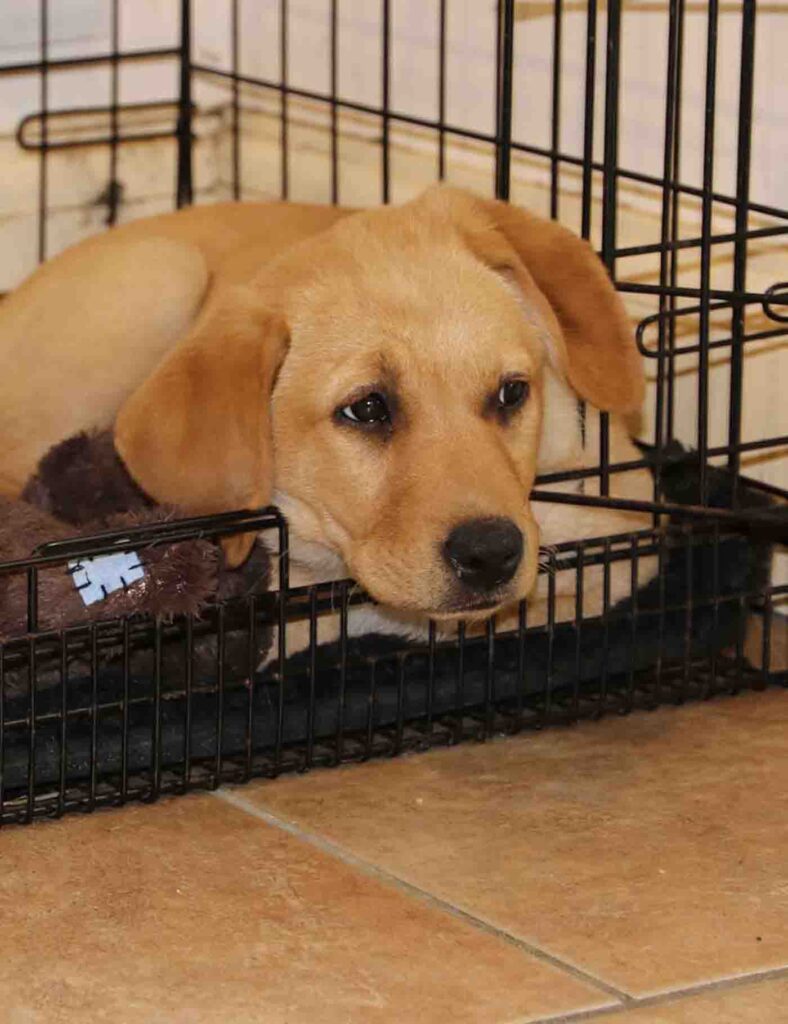
Most puppies take a from a few days to a few weeks to settle into their crate happily without whining every time you leave the room if you shut the door. Some puppies make no fuss at all from day one, others will cry at night for the first week, and other will cry much more persistently but there is usually a reason for this.
We’ll look at coping with crying in more detail in a moment, but the key to success within a week or two is to keep crate times short and sweet. And to leave the puppy something nice in the crate to keep him occupied.
Potty training
Being able to take responsibility to get himself to his toilet area and to wait for a while if no-one is available to take him out is a process that takes a puppy several weeks. But, with careful management, and sensible use of a crate, many puppies will be effectively clean and dry quite quickly.
You should be seeing very few accidents by the end of week three after bringing your puppy home. And your puppy will probably manage seven hours a night by the time he is three months old. These are rough averages of course, don’t despair if your puppy is a little behind.
How to set up your crate
Crate training your Labrador puppy should not mean isolating him from the family. The crate should be placed in a room where people pass through or spend a lot of time.
Puppies need company and should not be banished to a back room or basement or isolated for long periods of time. The kitchen is ideal in most homes. But any busy family room will do. Place the crate away from draughts and direct heat – be careful to avoid places that are in direct sunlight at certain times of day.
Bedding for crates
It is tempting to shop for pretty padded beds to place in the crate, but stuffed beds are often ripped open by Labrador puppies so it’s a good idea to start with something that is a little more resistant to chewing.
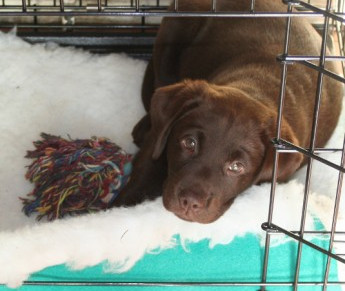
It can be difficult with some Labrador puppies to find any bedding that they do not destroy.
Purpose made crate mats are a cosy and popular choice. These simple mats come in a great range of colours and sizes to fit most standards. Veterinary bedding is an ideal crate liner as it’s soft and washable and can be cut to size, but if your puppy chews it up and swallows bits of it, you may have to think again.
Water bottles for dog cages
It isn’t a good idea to leave a water bowl in a puppy crate. He’ll just play in it and spill it everywhere. He won’t need access to water in the crate to begin with because you will not be leaving him in there for longer than an hour or so, except at night.
An eight week old puppy will be fine without water during the night-time hours. You can buy water bottles to attach to dog crates and cages, but if you are leaving the dog so long that he needs water, he should probably be in a puppy pen, or kennel and run, not in a crate.
How to crate train a puppy
Here are my four stages to crate training. I call them
- 1 – Introduction
- 2 – Happy place
- 3 – Crate on command
- 4 – Growing up
You can find a summary of these in my crate training schedule chart below
#Stage 1 Introduction to crate training for puppies from 8 weeks old
This stage covers the first week that you bring your puppy home.
Your objective at stage 1 is simply to get the puppy used to being in and around the crate with the door open.
Leave the door open
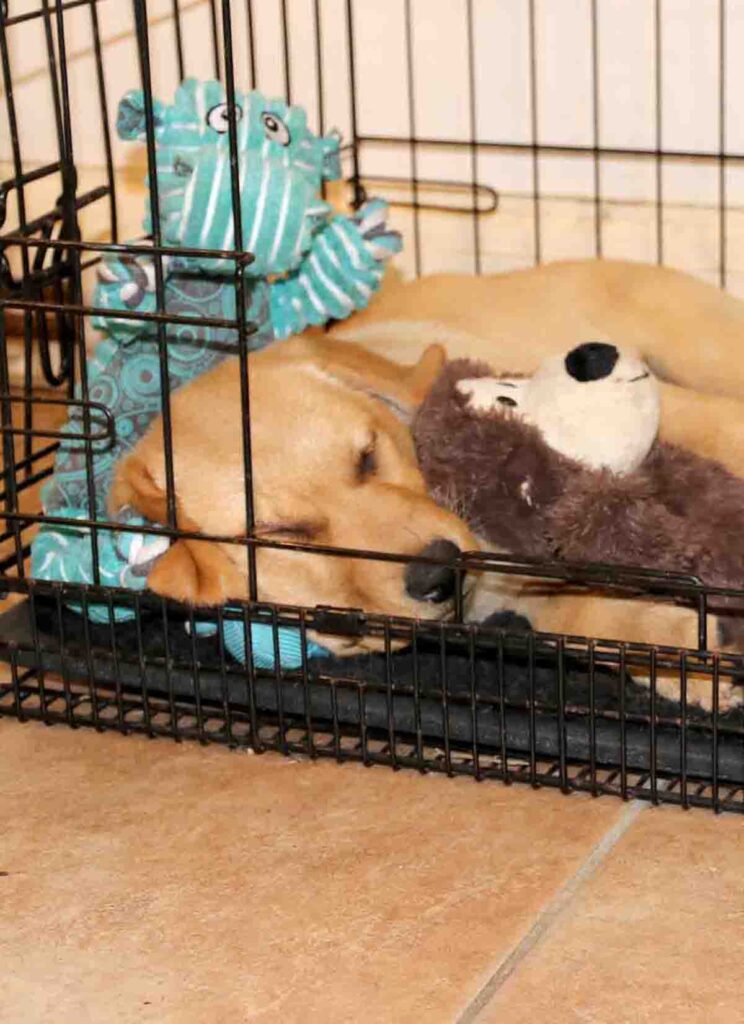
Start by placing puppy in his crate frequently and each time you place him in there drop several little edible treats through the roof for him.
Don’t shut the door on him during the day to start with if you can avoid it. Just let him come straight out again when he has finished his treats.
This introduces the crate as a fun and enjoyable place to be.
Sometimes, drop treats in there when he isn’t looking, so he gets a nice surprise when he goes in there to explore.
Each time you pop the puppy into the crate say “in your crate” in a cheerful and upbeat way. He will soon come to associate this phrase with going into his crate for a treat
Closing the door briefly
The next step is to close the crate door momentarily and then open it again.
Leave it shut only long enough for the puppy to finish his treat and notice that the door is closed. Then let him out.
Do not wait until he gets upset or cries.
Repeat many, many times during the course of the next day or two.
Crate training at night
During the night, for the first two or three nights, it will be helpful if you can have the puppy sleep in a sturdy deep sided cardboard box or a portable carry crate*(paid link) by your bed.
 (paid link)
 If he is left alone at night whilst he is still homesick he is likely to howl, and howling in his new crate is not a habit we want to establish.
Tending to your puppy during the night
If the box is right up against the side of your bed, you can put your hand in and comfort him if he cries. You’ll also hear him becoming restless if he needs a wee.
If he doesn’t lie down again and go back to sleep when you put your hand in the box, he probably needs a trip to his outside toilet area.
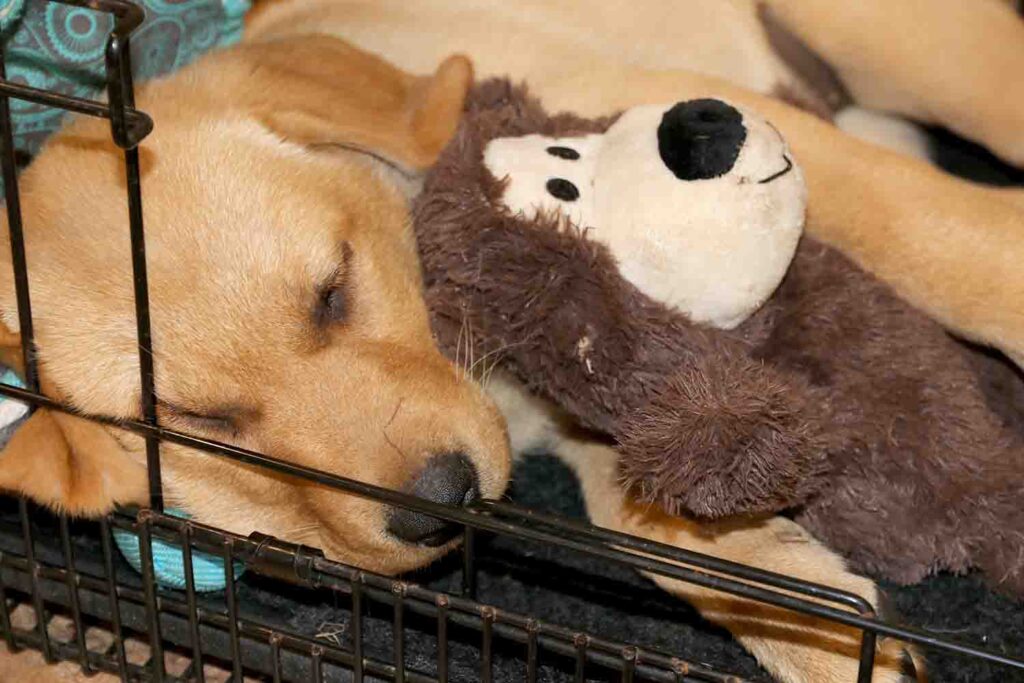
Moving your puppy downstairs at night
After the first three or four nights, or by the end of the first week, your puppy can be placed in his crate in the kitchen before you go up to bed at night.
He’ll probably cry for a little while, set your alarm for a little earlier than the time he has been waking for a wee and get him up and take him outside.
Don’t leave him more than five or six hours at night to start with.
So if you put him to bed at midnight, you will probably need to get up around 5am to let him out for a wee to begin with.
If a puppy has fallen asleep in his crate and slept for more than a couple of hours then you will need to let him out if he wakes up crying.
Getting more sleep!
If all goes well, you can stretch this five hours out by 15 minutes or so a night until you are getting seven hours sleep.
Feel your puppy’s bedding when you get him up in the morning. If he wets the bed you will need to get up earlier the next night.
I wouldn’t leave a puppy more than seven hours at night until he is around ten- twelve weeks old.
And some puppies will be 12 to 14 weeks before they can cope this long.
You can find lot more information on teaching your puppy to be clean and dry in our potty training sections.
Crate training during the day
There is no immediate need to crate your new puppy during the day for more than a few minutes at a time.
The main purpose of crating a puppy during the day is to
- Help the puppy learn to hold onto the contents of his bladder for a bit longer.
- To keep him safe when you are busy for short periods, or if you need to leave the house for a while.
- To give him chance to calm down or a break from small children.
However, you do need to get the puppy used to spending longer periods in the crate in preparation for being left alone from time to time when he is older.
So gradually, you will accustom the puppy to a few longer spells in his crate.
The reason some ‘training’ is involved is simply that the puppy need to learn to accept being in the crate without making a fuss.
And the next step in this process, or what I call ‘Stage 2’ in crate training, is making the crate his ‘happy place’
#Stage 2 Making the crate a happy place
For this stage, you are going to need at least three puppy Kongs*(paid link). These are tough hollow rubber toys that you fill with mushy food and freeze.
 (paid link)
 You can freeze several Kongs at once by standing them on a baking tray in the freezer.
Each time you put the puppy in his crate for more than a couple of minutes, you will leave a frozen food filled Kong in there to keep him company.
Puppies love these and will soon grow to associate the crate with the pleasure of the frozen Kong.
Here’s how you get the puppy used to being in the crate with the door shut.
How to get the puppy used to longer crate times
Once you have got to the end of the first week and the puppy has accepted the crate as a nice place to be, the next task is to get the puppy to accept the closed door for longer periods of time.
This may take a day or two.
Place him in the crate with his frozen kong and close the door for 30 seconds.
The idea is to leave the door closed for a few seconds longer each time you crate the puppy. But it is very important only to open the door when the puppy has been silent for several seconds.
What to do if the puppy cries in his crate
If the puppy starts to whimper or howl you will need to turn away from the crate and ignore him.
Busy yourself in the room but don’t look at him and don’t be tempted to open the door.
Wait for the silence as he stops crying and gets to work on his puppy kong.
Tell him what a good dog he is. Let him out immediately and go back to much briefer periods of closed door for a while.
Try ten seconds or five.
Build up again gradually, but do not be tempted to avoid crating him because it upsets him.
Once the puppy is happy in his crate, you can use it to help with his potty training.
Until then, make sure that you crate him for very short periods when you know his bladder is empty. Otherwise he will wet himself when he gets upset.
Puppies that cry need crating more often!
If your puppy whines in the crate, you need to crate him more often not less, and for shorter periods. Check out our in-depth article on coping with a crying puppy for more information
Just make sure that each time he is crated is very, very brief to begin with. That way he will learn that being crated is not a big deal
Warning: if you open the crate door whilst your puppy is howling, he will howl longer and harder next time!
Build up slowly to a minute, then two minutes, then three, five, seven, ten, fifteen minutes and so on.
How long can a puppy be left in a crate
People often ask how long a puppy can be left alone in his crate. If you ask ten experts this question you’ll get ten different answers, from “never leave a puppy in a crate” to “four hours or more”
My own personal rule is never to leave a dog over six months old in a crate for more than four hours at a stretch.
I personally wouldn’t do this on a regular daily basis either, though I know that many working puppy parents do.
For puppies three to six months old I think two hours is a maximum, and for puppies under three months, one hour.
If you need to leave your puppy for longer than this, then you need to consider a puppy proof room or pen where water and puppy pads are always available, or even a weatherproof outdoor kennel and run.
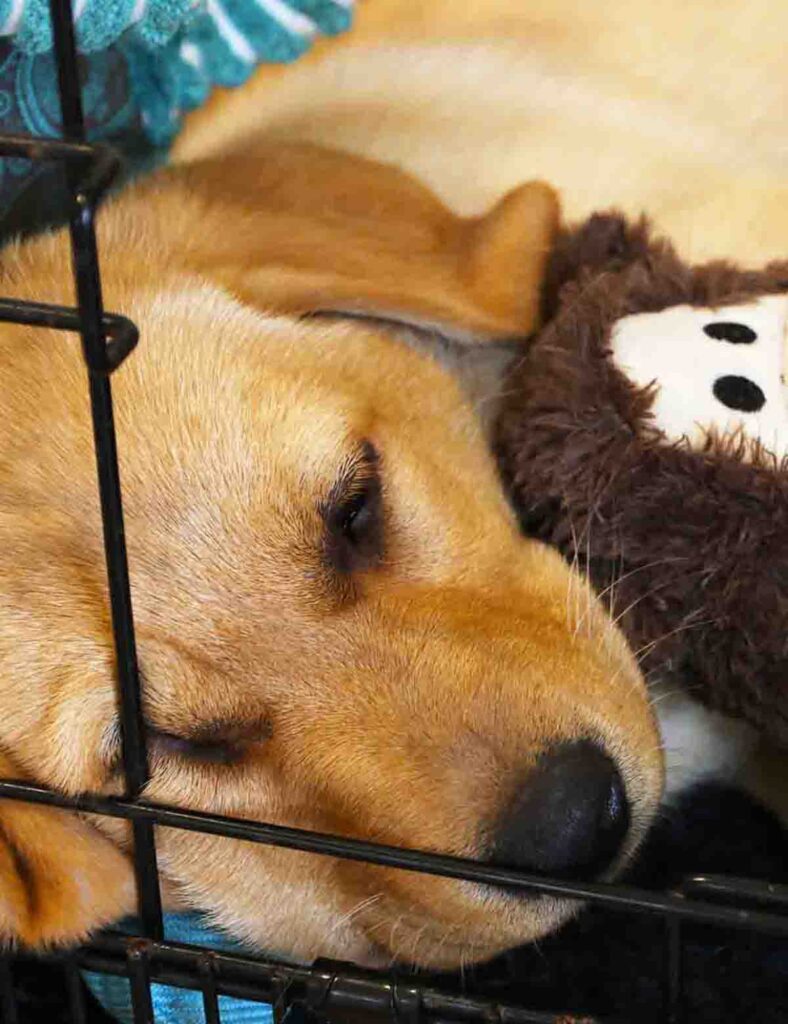
Crating your puppy while you work
It isn’t appropriate to leave puppies in crates for long periods of time, so if you are returning to work while your puppy is still small.
And don’t have anyone to help with his care, you’ll need to use a different system of potty training.
This involves putting puppy pads down in a large puppy pen or puppy proofed room so that your puppy always has access to a toilet area.
You can find out much more about overcoming the problems of being a working puppy parent in this article: combining a puppy with full time work.
#Stage 3 Training your puppy to go into his crate on command!
As your puppy grows bigger, picking him up and putting him in his crate becomes more of a physical event!
You don’t want to get into a situation where you have to chase your puppy around the kitchen and physically push him into his crate each time you go out.
So it’s a great idea to teach a puppy to go into his crate on your command or cue.
Provided you are not leaving your puppy alone for too long, he should be happy to go willingly into his crate.
This can be achieved through training.
Choosing a cue or command
It doesn’t matter what cue you choose. If you have been saying ‘into your crate’ each time you place the puppy in there, and he is happy to be there, then stick to that.
If you have got yourself into a situation where your puppy doesn’t want to go in his crate then choose a new cue, like ‘bed’ or ‘kennel’
It can be any word you like as long as it is not one he associates with anything unpleasant.
Advance crating
Until you finish the training, you’ll still need to physically put your puppy in his crate before you go out.
To avoid your puppy associating the crate with anything he doesn’t like (you leaving home for example), from now on and until you finish your training, crate the puppy at least ten minutes in advance of your departure, and don’t forget to make sure that there is always a nice kong full of frozen food waiting in there for him.
Training the ‘crate’ cue – or crate on command
You can now teach your puppy or older dog to go into the crate on command or cue.
This will probably take a couple of weeks. Maybe more if your puppy really does not like his crate at the moment.
Have several training sessions each day – at least three. And do 20 or 30 repetitions of the following exercise in each session.
This will take you about five minutes.
You will need a ‘clicker’ or other event marker.
If you are have never used one before, check out this article before you begin: Charging your clicker. You can use a word instead of a clicker, but you still need to ‘charge’ it
EXERCISE 1 approaching the crate
Have a pot of treats ready to hand on the table or in a treat bag attached to your waist.
Imagine a zone around the crate.
Visualise the boundaries of the ‘zone’. It should not be so small that the dog avoids it altogether. A couple of feet in each direction is fine.
The object is to get your puppy to choose to enter this zone.
- Have the dog in the room with you
- Make sure the crate door is wide open
- Click and treat (C&T) each time the dog enters the crate zone
- Immediately after your click, throw the treat outside the zone so that he has to re-enter to get the next reward.
- Repeat 20-30 times or for about five minutes
Note that this is different from ‘luring’ the puppy into the crate by putting treats inside it. You are teaching him to chose to approach the crate.
EXERCISE 2 entering the crate doorway
In this exercise, you are going to click and treat the dog for putting a nose, or a paw through the opening into a crate.
For some dogs this is too big a jump and you will need to work on a smaller crate zone first.
We are moving the goalposts and the dog will be surprised when you do not reward him for entering the zone.
He will quickly try something different.
To begin with we will do a few repetitions of the exercise he knows, just to get him ‘into the game’.
- Have the dog in the room with you
- Make sure the crate door is wide open
- Click and treat each time the dog enters the crate zone
- Repeat five times
- Throw the treat outside the zone so that he has to re-enter to get the next reward.
- The next time he enters the zone, wait for him to go closer to the crate and put his nose in the opening
What if he fails to do this?
If the dog wanders off without putting his nose into the crate entrance, start to C&T for entering the zone again.
Repeat from step 3 until the dog repeatedly puts his nose through the crate door.
Now you can stop rewarding him for simply entering the zone.
Intermediary steps for dogs that don’t want to go near the crate are rewarding him for
- Putting his nose within one foot of any part of the crate
- Placing his nose within two inches of the crate
- Putting his nose within two inches of the crate doorway
And so on.
You can’t fail at this. It just takes longer with some dogs than others. Use his entire food ration if necessary.
Don’t give in, he’ll do what you reward him for as soon as he is hungry.
Remember, if you have to go out, scoop him up without a word, and place him in there bodily.
Do not use the clicker or any other part of this process, or attempt to lure him in.
You going out is a punishment in his mind. Behavior that is punished will diminish.
EXERCISE 3 inside the crate
In this exercise the puppy walks right inside the crate. When you click, he will come dashing out again for his treat.
Again, we begin the exercise with something we know he can already do
- Have the dog in the room with you
- Make sure the crate door is wide open
- Click and treat each time the dog puts his nose through the crate doorway
- Repeat five times
- Throw each treat outside the zone so that he has to re-enter to get the next reward.
- The next time he puts his nose through the doorway, withold the click. Wait for him to go further in
- Repeat and gradually raise the criteria you are setting so that more and more of the dog must be through the doorway to get a reward.
The exercise is done when the dog repeatedly goes right inside his crate. With a dog that is not crate-shy, you can often work through these three Exercises in a day or two.
EXERCISE 4 spending time in the crate
- Have the dog in the room with you
- Make sure the crate door is wide open
- Click and treat each time the dog goes inside the crate
- Repeat five times
- The next time he enters the crate withold the click and treat for two seconds
- If he remains in the crate click and treat
- If he leaves the crate wait for him to re-enter
- Repeat from step five until he can wait 2 seconds in the crate and then increase to 3 seconds
- Work your way up to ten seconds
When the dog can cope with ten seconds waiting in the crate, you are ready to close the door. To begin with this will be momentary
EXERCISE 5 closing the door
- Have the dog in the room with you
- Make sure the crate door is wide open
- Click and treat after 10 seconds, each time the dog goes inside the crate
- Repeat five times
- The next time he enters the crate close the door and immediately open it again
- Wait a few seconds then
- If he remains in the crate click and treat
- If he leaves the crate wait for him to re-enter
Repeat from step five until he will go into the crate, watch you open and close the door, and remain in the crate for a few more seconds after you have opened the door.
We are nearly there!
EXERCISE 6 adding a cue
Now we are going to give this behavior a name. My crate command is ‘In Your Crate’. Use the cue you have chosen.
Make sure it isn’t too long a phrase and that it doesn’t sound too much like any of your other commands.
You know the procedure now. Here are the standards and criteria for exercise 6
- Click and treat the dog for entering the crate as in the previous exercise
- Don’t close the door every time
- Vary the number of seconds you expect him to wait in there for
- Start saying ‘in your crate’ quietly as he enters the crate
- To begin with he may start rushing out when he hears your voice and before he is properly in the crate
- He is just curious, be patient
- Click and treat without the cue a couple of times and then try again.
You are done with exercise 6 when you have done several sessions over more than one day, adding the ‘in your crate’ cue as the dog enters the crate.
We want him to have absorbed the association between this cue and the act of entering the crate. Now it is time to use the cue in advance of the behavior.
EXERCISE 7 responding to the cue
Have your treats to hand, but wait until the dog has lost interest, and decided you do not want to play the ‘crate game’
- Have the dog in the room with you
- Make sure the crate door is wide open
- Wait until the dog is away from the crate
- Give the cue ‘in your crate’ Do not repeat it
- If the dog goes into the crate click and treat
- If he doesn’t immediately go to the crate, walk towards the crate with him, and point to it
- Make encouraging noises and C&T immediately he pushes his nose through the door
- Then click and treat him a few times for entering the crate WITHOUT the cue
- Now do something else with the dog for a moment, stroke him, ask him to sit a few times, and then try again from step 4.
Once the dog is repeatedly racing into the crate on your cue, we need to make sure he can distinguish this command from other commands.
It is very common for a dog that has had intensive training like this to respond by ‘crating’ himself every time you get your treats out.
In this case the dog is not discriminating between different cues, but rather making assumptions about what game you are going to play.
So the next step in training is to mix in another cue.
The simplest is to alternate crating with ‘sit’.
EXERCISE 8 mixing cues
Using exactly the same principles as above, click and treat your dog several time for sitting to the command ‘SIT’.
Then use the cue ‘IN YOUR CRATE’ At this point many dogs will SIT.
If he is confused, and he may be, show him what you want, just like before. Follow this with several ‘In Your Crate’ cues and then mix in a few ‘SITs’ again.
Repeat until the dog can respond appropriately to either ‘In Your Crate’ or ‘Sit’ no matter what order they are given in, nor how many of each you ask for in turn.
 (paid link)
You now have a dog that actually understands the meaning of In Your Crate and happily complies with your command.
It is time for him to adapt to being confined after being told to go in there.
Start slowly and build up
EXERCISE 9 adding duration
- Place a Kong with food in it, or some treats on a slow feed bowl into the crate without your dog spotting you
- Cue the dog into the crate (call him into the room first)
- Shut the door and leave it closed for one minute
- Open the door again and ignore the dog. It is up to him if he stays in the crate or comes out
- Repeat from step 1 gradually increasing the time you wait before opening the door
Vary the length of time you keep the door closed. Sometimes two minutes, sometimes as much as fifteen minutes. Keep repeating this exercise with lots of short crate times and the occasional longer one until you are occasionally leaving the dog in the closed crate for up to half an hour without any decrease in his enthusiasm for responding to the ‘crate’ command. Now you can begin to send the dog into his crate for longer periods, such as when you go out for an hour or so.
Maintenance tips
- Send the puppy into his crate often, not just when you need to.
- Make sure there is always a tasty treat or a Kong in there waiting for him
- Sometimes when you send him in, close the door
- If you know you are going to go out shut him in at least ten minutes before you start getting ready to leave
- If you know you are going to go out always leave him with a Kong full of frozen food
- When you are not going out, vary the times he is shut in from two to thirty minutes
- Send him in from time to time without closing the door
Provided your dog is not left overly long in a crate on a regular basis, this should overcome any shyness he has about going in there. Don’t forget that other than during the night, dogs should not be left in crates for long periods of time.
Dogs of any age can be trained to crate on cue using this system. For more information on using a clicker check out : Ten great reasons to start clicker training
#Stage 4 Growing up
By twelve weeks or three months old, many puppies will be sleeping 7 hours or more at night and going happily into their crates on cue, if they have been taught to do this. You probably won’t be able to have a ‘lie-in’ on a Sunday morning yet, but things should start to get easier for you.
One thing to watch out for at this point is a sudden increase in ‘accidents’. This tends to happen at the three or four month old mark as we ‘take our eye off the ball’ and stop supervising the puppy so much, or start leaving them in the crate a little too long.
When to let your puppy out of the crate at night
If all goes well, by about six months of age, your Labrador puppy should be clean and dry in the house, and sleeping soundly through the night in his crate. At this point, many puppy owners breath a big sigh of relief and start to look forward to the prospect of removing this massive and annoying crate from their kitchen for good.
Let’s face it, a cute dog basket with a nice cosy liner looks a lot more attractive in your home, than a great metal cage. So, at what age is it OK to start leaving a puppy loose in the kitchen overnight? And how do you get your dog used to a basket or dog bed, rather than sleeping in his crate?
Age related crate training schedules
Most people are reluctant to give out information on how long a puppy should be crated, or what to expect at different stages, because puppies are so different from one another.
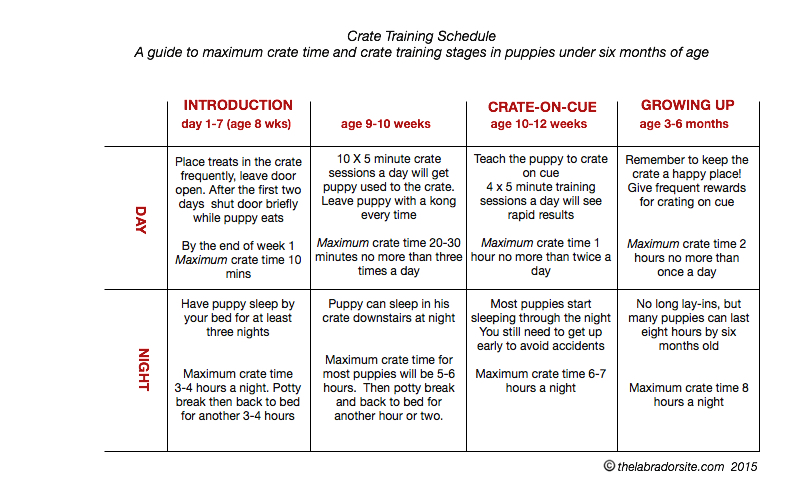
But I know how important it is for you to have some idea whether or not your puppy’s behavior and progress is normal. So, I have included a rough guide or puppy crate training chart above.
Please don’t feel your puppy must fit the profile for his age accurately. It really is just a rough guide.
Your best approach is to simply follow the four stages outlined above, from start to finish, and not worry too much about where your dog is at the moment.
In the meantime, if you are worried about your puppy’s progress with crate training or are having problems, do drop into our support forum and ask for help!


Free Labrador Updates!
Get my training tips, news, reviews, and the latest from The Labrador Site delivered to your inbox
I wonder if you can help me. I am having a terrible time transitioning my one year old out of the crate. There is not one skirting board she has not chewed. She has chewed both seats of my expensive sofa, 2 ugg boots, I am at my wits end. I watch her on the camera and she falls asleep and then when I do she goes nuts destroying my house.
I cannot spend 24/7 playing with her. It seems if I don’t she cries and I can’t leave her unattended for a minute now because she will chew. The bitter sprays do not work with her.
Any help would be so greatly appreciated.
Sorry to hear that Leah. Try this article for some tips: https://www.thelabradorsite.com/how-to-stop-a-dog-from-chewing/
And do pop and see us at thelabradorforum.com if you’d like to chat further 🙂
Hi there,
thank you so much for all of this amazing advice. Can you please tell me if you advise if the crate door is to be shut at night or not? If we shut the door we will be able to put our 4 year old lab (not crated) and our puppy in the same room, but if we don’t shut the door I presume we will need to seperate them until we know we can trust them together at night? Thank you so much for your advice!
Is it ok to introduce my 4 month old puppy to a crate ? We have had her for 2 months now but thinking of getting a crate now , so that she can have her den. But am worried if it’s ok after 2 months of her being with us. Please advice. Thanks
Hi there, am coming to you at the end of my tether! We have only had our lab puppy for 4 days but despite being happy in and out of his crate during the day, we have had zero success at night. Last night he howled, cried and barked for 6 hours straight with probably 4 or 5 quiet times of maximum 2 minutes each time. He’s 9 weeks old so I need to let him out during the night, but it was impossible to do that when he was quiet, because he just wasn’t! So now he probably thinks if he keeps going long enough someone will eventually come to him. I absolutely do not want to give up but my husband is ready to and that is really not what I want, as the puppy must be able to be left for short periods, not just overnight, so he’s going to have to get used to it. The crate is large but with a divider, so it’s not easy to bring upstairs so we’ve just left it in the lounge constantly. We’ve left a light and the radio on but nothing has helped. And now I’m wondering if he’s too young and whether I should get a smaller crate and have him in the bedroom for a few weeks? Any advice would be so appreciated as we are absolutely sleep deprived 🙁
Hi Anna, sorry to hear you’re having trouble with your puppy crying! Our guide on how to cope with puppy crying has lots of tips that should help your puppy settle in. But if you need any more advice, we also have a guide to 9 Week Old Puppies, including schedules and what you can expect. Hopefully these will help, Meg.
Hi Pippa,
I’ve been reading your books and trying to implement your techniques with my almost 9 week old Labrador puppy. I’m having a lot of trouble with his biting, nipping and chewing of my person. Is it appropriate to crate him to calm him down when he is biting too much? Do you have any tips on what to do when he bites me? He loves to chew on my fingers but he also nips my legs, sometimes is rough on my hands and arms. I know he wants to play, and I try to redirect his attention to his toys but oftentimes he is adamant about biting me!
Grab the A1 and Barbie that cheeky lab
Hello
Just needing some help with our 8 month old lab .she has destroeyed everyrhing from plants to pools bbqs chairs and anything she can get to .It mostly happens through the night and eatly mornig .I feel she knows that she has done wrong and i am trying to ign ore the behavior but I am reaching my wits end .Is it too late to crate her at night .Getting desparate and need some help before we resent our beauriful Lab
Carol
I have a 8 week old puppy that is screaming every time i leave her in the crate and walk away. She is fine when she can see me i have been reading as much as possible to try and help her cope but its not working. HELP!!!
What are some tips for me to help her or something other have did so i can maybe try that.
What shows the puppy it is nightime and that she can hold on longer?
What shows the puppy it is night time and that she can hold on longer?
Hi Pippa,
I have a 12 month old black lab, who we keep in our dining room (barriers in place). When we are not hoe during the day she stays inside the dining room, which her crate is also in. She is very good at staying in her crate and sleeps in her crate all night long with it closed and does not use the restroom nor cry. When we are not home and she is the dining room she is good about going pee on the pads however she goes number 2 wherever she feels just on the floor. Often she when we come home she will not peed inside at all but has gone number 2 on the floor; and when we take her out she pees everytime (# 2 sometimes, but not always) then shortly after when we bring her back inside she might go #2 on the floor, as if she thinks it is okay to do this. Any tips or tricks on this?
Hi,
our 4 month old does the same thing. What we decided was to wait 5-15 minutes outside for each potty break. If our lab doesn’t go # 2, then we place him back in his crate for 5-15 minutes and then try the potty break once more. If that doesn’t work, then we go out every hour.
Hello I have a gorgeous 7 month old male chocolate lab who I am having problems with his toilet training during night time. A couple of friends have suggested I crate him at night and one of the other members on the forum suggested the same. I did try crate training with him when I first had him at 8 weeks but he would howl and whine constantly so after 2 weeks I gave up. I’m just wondering whether at 7 months it’s too late to try again. Any advice would be helpful
Hi Ann,
same bout here. We took Pippa’s advice about placing our 4 month old lab in the crate and pinpointed when he went potty in the crate. The next night, we set out alarm clock 30 minutes prior the last time. We usually try to go to bed around 11pm-midnight, so 5-6 hours is our mark. I will be setting my alarm clock tonight for tomorrow morning.
Hey Pippa,
Are the mats you mentioned for the crates durable for puppies?
Thanks,
Tina
Hi Pippa….just wondering what to do about our house cat who is NOT accepting our new Lab pup. She attacks and is relentless…this is getting worse, not better? Our pup just wants to play but tries to chase and I can’t keep them apart all the time? Any advice? We’ve had the cat over 14 years and she’s set in her ways. We do crate the pup at night, she’s 12 weeks old already. Doing better all the time. But it’s not safe letting her free in the laundry room next to the kitchen as that’s where the catbox is? Help? And thanks in advance. S
Hi Pippa, your site is our saving grace. We are beginner lab owners and our 9 week pup is keeping us coming back for more and more advice. Crate training is working well – yay! However, Rossi seems to be jumping on the couch alot and crying if he can’t get up. We’ve ignored him, prompting him to get back in his little bed (his supervised play and nap area which sits on the floor in the lounge by the couch) but he is a persistent little bugger! He wants couch! I think our mistake was we’ve cuddled him a few times in our arms whilst we’ve been on the couch and he probably thinks he has the couch privilege now. Should we pop him in his crate for time out during these episodes, or would he associate the crate as punishment?
My trainer suggested scat mats to keep large dogs off furniture. They work excellent. He only touched them once. Now stays clear.
Hi, I just had a quick question. I have a 7 week old lab, he’s been really good about sleeping in his crate and I ignore all whining, after if taken him out once and a full 1-1.5 hrs has passed. Tonight, he relieved himself multiple times before bed and I usually stop giving water after around 7pm. He slept a solid 3 hours, woke up and we didn’t engage him because I want him to learn that a whine is the appropriate signal to tell me he needs to pee/poo. So, he woke up after the long sleep, made a minor whine but immediately began playing on his own and no other whines or howls occurred. Then he went back to sleep! I was just wondering if I’m the one who should just take him out even though there was no whine because he’s young? Or am I lucky and his learning to play.on his own in his crate at night quietly starting to work? I should note the previous nights he’s made clear whines where I get up every 1-2 hrs and take him out to pee/poo with no play at night and come straight back. any proceeding whines are completely ignored. Also I sleep on a couch next to him and watch TV, sleep, go on my phone which he can see. Sorry if I ramble, just giving you the whole story. the main question is without the whine do I need to take him out? P.S. he pooed 2-3 times during the day and let out some smelly farts during the sleep tonight (but he also has a bad habit of eating grass which I’m trying to curb– any tips with that are much appreciated)
We have a 7 week old puppy. She was kept her first night in our bathroom with a gate and the door open. The door open to view our bed and is just within a few feet of the door. I did not know a puppy needed to go out every 2-3 hours at night so we did not do that and her first night she did not have a crate. We expected messes and there were plenty of messes. The second night we have had a crate but we did not close it up and so we woke to many messes again. Today though and last night, this is the third night, we noticed that when we take her out she will go potty and we praise her and bring her in and within a few minutes she is dribbling pee on the carpet. Meaning she squats and goes a little bit on our carpet. We say “No.” And take her outside. This was happening yesterday and today and went on for about three hours. Then we put her in our bathroom for a while after playing but did not close her in the crate and found messes after 10 minutes and she had just went pee outside (not to mention the dribbled accidents in between) and she had poo’ed. What is happening? Its like she always has to go and isn’t holding it at all. She will play and sleep for periods of time so she can hold it she just isn’t why is she not totaling eliminating when we take her out? What all are we doing wrong and what other issues do you think we may have to deal with because of these issues? We have only had her for 3 days. We have not been home much due to the busy weekend which is not common for us. Could it be that she has not been anywhere long enough to feel at home? Are we stressing her out? We really want this to work. We are a family of 6, including pets a family of 8. We also have a cat. I have a 3 month old (yes I know I am insane for getting a puppy now), 3 year old, 6 year old, and an 8 year old. I am a stay at home mom. And will be the one to train her primarily. Please help!
Thank you,
Amanda
Hi Amanda, she is just a baby, and this will take weeks, not days to get right, so you need to put your patient hat on 🙂 Here is the house-training article you need: https://www.thelabradorsite.com/house-training-your-labrador-puppy/ At seven weeks old, your puppy will wet herself whenever her bladder is getting full, whenever she is excited, and whenever she is scared. So saying NO or getting annoyed will often make a small puppy dribble urine. You have to completely ignore any mistakes or puddles and focus on getting her to wee outdoors using frequent visits and lots of praise. Follow the instructions in the link I have given you, and join the forum for support
Hiya pippa,
I have a gorgeous red fox femal lab ruby she is now 9 months old and we adore her I never ever thought I coukd love a dog so much lol
we got her when she was 12 weeks old and have crated her from day one at nite and dhring the day when we have left her for short periods
crating at nite has always been abit up and down we woukd have 3 or 4 nites and we wouldnt bear a thing from her till may b 6am
then we would get a couple of nites where she would just cry and cry
then she got tbst she was waking at 3am every morning crying and would not settle at all no matter what we did so I said to my husband lets risk it and leave her crate door open so she came come in and out if she likes ( crate is in our living room)
The first 3 weeks she was amazing not a peep and no mess when we came down in tbe morning about 6:30
even stopped crating her during the day aswell
but the last week every morning we have come down tbefe has been 2 or 3 piles of poo she doesnt cry and she is doing it near the door so confused going 3 weeks perfect now pooing at nite but left during the day out if cratd perfect we left her 8:30 am till 2pm and no mess or wee any where absolutely perfect could u share some light on this as I am totally confused how 3 week can b perfect then all of a sudden its not tonite I am putting her back in her crate but fully expecting crying and barking again please help !!!!!