

Chocolate Lab – Your Guide To The Chocolate Labrador Retriever
The Chocolate Lab is a friendly, confident and loving dog with great character and huge appeal as a pet. You may have heard rumors that chocolate labs are less intelligent and more prone to health problems than their yellow and black Lab cousins. So we’ll be clearing up a few myths, and finding out if there is more to the chocolate Lab than just fur color!

- Where did chocolate Labs come from?
- Coat color, shades, and easy genetics
- English vs American chocolate Labs
- Traits: What to expect from your chocolate Lab
- Are chocolate Labs stupid?
- Silver vs chocolate Labs
- Finding Chocolate Labrador puppies
- Chocolate Lab training
- Old chocolate Labs

I’ll share my experience of raising and training chocolate Labradors. We’ll look at what you can expect in terms of temperament, behavior, and physical characteristics. And I’ll help you with feeding and training your dog, from puppyhood to old age.
Meet Rachael
This is my chocolate lab Rachael as a puppy. Rachael was a female chocolate retriever from a mixture of American and English Lab lines.

Rachael was a huge source of inspiration for this website, so this is a little tribute to her and a thank you for all she has taught me.
Where do Chocolate Labs come from?
Labrador Retrievers were recognised by the UK Kennel Club in 1903 and by the AKC in 1917. The Labrador breed was developed mainly by a couple of English aristocrats in the 1800s, from dogs they had imported from North America.

Although our early Labrador Retrievers were predominantly black, throughout the history of the breed, chocolate Labrador dogs (sometimes referred to as liver Labradors) have appeared occasionally in litters of puppies.
Way back in the last century, chocolate puppies were sometimes culled at birth! Black Labs were adored, and black was the only color considered respectable for a Labrador.

Fortunately those attitudes are well and truly behind us, and in the last few decades the chocolate Lab has gone from strength to strength.
How is the Chocolate Color Inherited in Labradors?
To understand how brown puppies can be born to two black dogs, we need to take a peep at how coat color is inherited in the Labrador retriever.

The instructions that tell your dog what to look like, and what color to be, come packed in genes. And genes come in pairs. This is true for the gene that determines whether or not the Labrador will be brown (this gene is called b) or black (B). Every Labrador has either two genes for a black coat (BB) or two genes for a brown coat (bb) or one of each (Bb).

The color black in Labradors is dominant. That means that if a Labrador has one gene for the color brown, and one gene for the color black, the dog will be black.
The hidden gene
This is because the black gene switches off the brown one. The brown gene remains hidden, doing nothing in particular, while the black gene takes control of fur color.
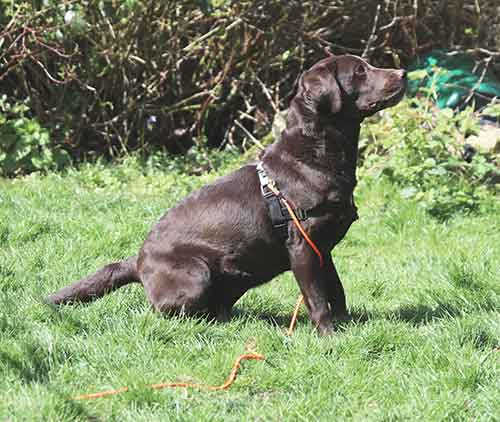
The brown gene only gets to be in charge if it is paired with another brown gene. But a black Labrador can sneakily carry a brown gene (Bb) and pass it along to his children. This is how the color brown can remain hidden in generation after generation of black Labradors.
Chocolate Labrador Shades
Unlike our yellow Labradors – which come in a wide range of shades, the color chocolate is pretty consistent in puppyhood. Most chocolate Labs are quite similar in color, though eye color can vary from gold to dark brown.

The color of your adult chocolate Labrador Retriever boy or girl’s coat will, however, vary depending on whether the coat is newly grown after a molt, or is about to shed.
As the old hair dies it starts to lose some of its color, and the dead hair is much paler than the glossy dark chestnut-colored coat that will soon appear.
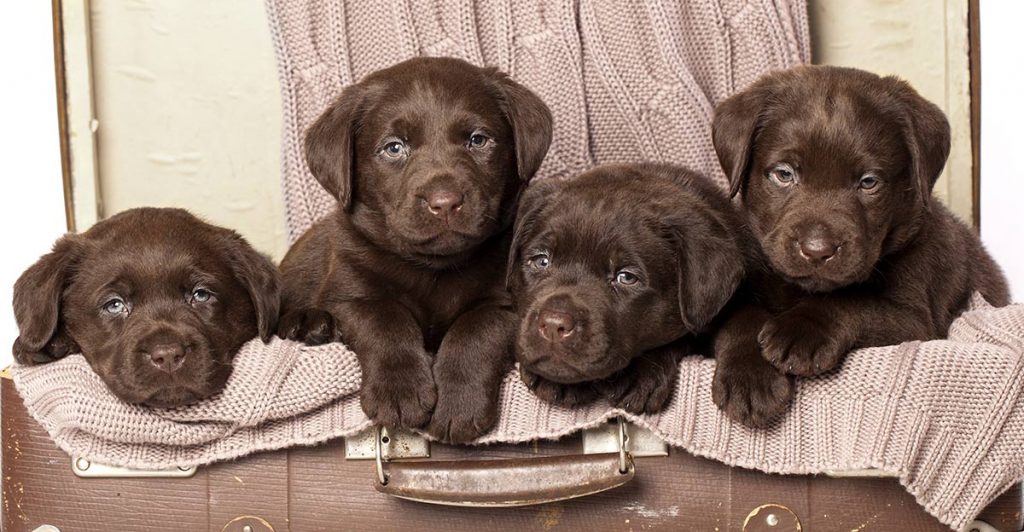
And though some chocolate Labs are darker than others, even when taking the stage of molt into account, variations between individuals are fairly small, with one very contentious exception. The Silver Labrador, which is a variation of the chocolate fur color.
We’ll be looking a bit more closely at that below.
When did Chocolate Labs become Popular?
By the 1920s and 30s a few brown or liver Labradors, as they were then called, were making an appearance on the shooting field.
But for some years more, brown was not widely acceptable to Labrador enthusiasts. It wasn’t until the 1960s that brown Labs began to really grow in popularity.
The demand for these beautiful dogs came from ordinary home owners and they much preferred the word ‘chocolate’ to describe their companions.

That preference continues today, and we often name our brown Labs after favorite snack bars and chocolate flavored drinks! You can however still register chocolate Labradors as ‘liver’ in color.
Different Types Of Chocolate Lab
As the popularity of Labs began to expand beyond the shooting community that developed the breed, they began to split into two different types.
Those dogs mainly bred for show and companionship. And dogs mainly bred for hunting and retrieving.

English Chocolate Lab
English Labs are those bred for Shows. The first chocolate English Show Champion Labrador Retriever was Cookridge Tango in 1964. The 1960s was a turning point in the popularity of the chocolate Lab, but interest grew slowly at first.
Gradually, the public began to demand more chocolate Lab puppies, and breeders began to produce them. Over the next few decades, Chocolate Labradors became increasingly popular both in the show ring and as pets. In the shooting community, where Labradors were expected to do a job of work, the preference for black continued throughout the late 1900s, and into the present day, particularly in the UK.
American Chocolate Lab
American chocolate Labradors were bred to work, and are also known as field Labradors. The chocolate Lab has now become more established in the working community, but they are harder to find. There is a rumour going around that this is because brown Labradors are a bit stupid! We’ll look at that below.
 Chocolate Lab Characteristics
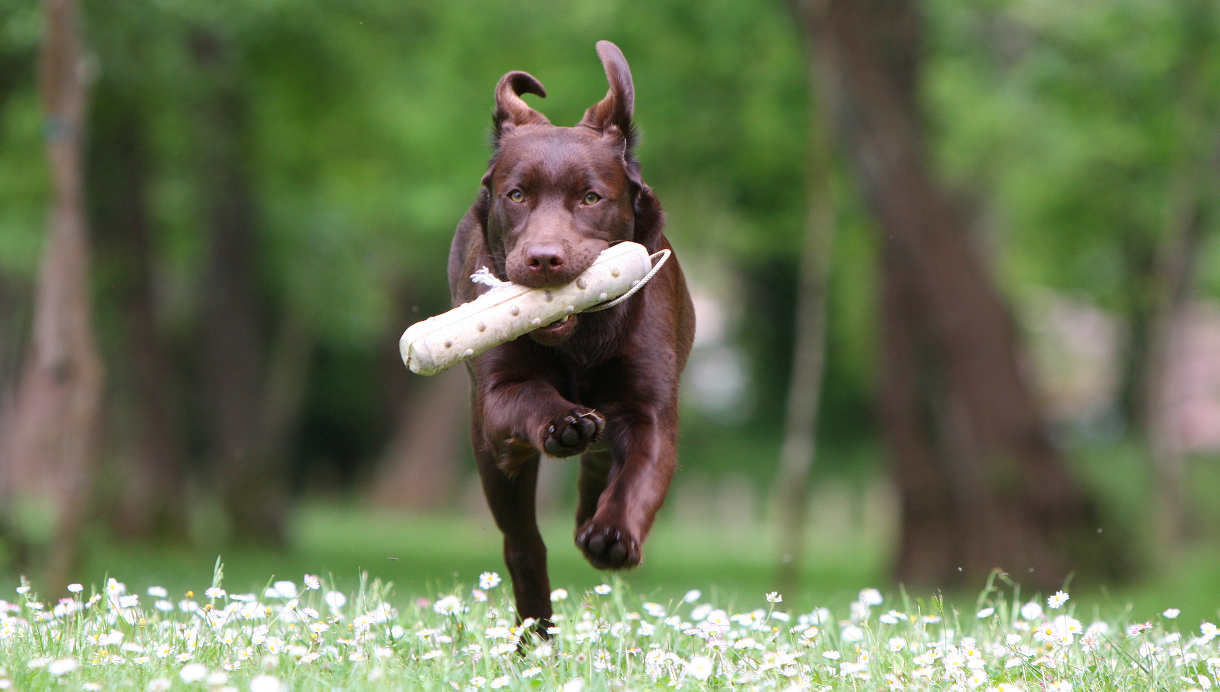
The split that occurred between show lines and working lines of Labrador, affected different colors of Labrador in different ways.
The black Lab remained the popular choice of the hunting fraternity, while the popularity of the chocolate Lab took off largely outside of the hunting community. And the traits or characteristics of chocolate Labs reflect their primary role as pets or companion dogs. As a result there are differences not only in temperament, but also in size and shape.
How Big Do Full Grown Chocolate Labs Get?
Show Labradors (English) are more heavily built, somewhat slower, and physically less agile than their field bred counterparts. Some English brown Labs may reach 80 or 90lbs without being fat or overweight. Whereas American chocolate Labs are often lighter.
My Lab Rachael, for example, weighs less than 60lbs. Most males of her build will weigh five or ten pounds more. English chocolate Labs are also more likely to have a chunky Labrador head and thick otter tail.

And while some feel that the chunkiness of the skull has been taken too far in show lines, there is no denying the beauty of a classic Labrador head.
Show Labs also have smaller ears and a wider muzzle. A brown Labrador is more likely to be from these show types of bloodline and are therefore more likely to share these general characteristics. But there is more. It isn’t just body shape that is inherited.

Chocolate Lab Temperament
American Labs may have a more intense retrieve drive, or urge to chase and retrieve things than their show bred cousins. They also tend to be not only physically faster and racily built, but more ‘sensitive’ and responsive to training.
Field bred Labs tend to be quite dependent on their handler’s approval. In short, they are desperate to please. Over many generations this biddable quality has been bred into our working Labs alongside their retrieving and hunting prowess. This has given working dogs a rather different temperament from our show stock.
Chocolate Lab Intelligence
In show dogs you may see a more robust temperament. An English chocolate Lab is often less concerned over the little ups and downs of life. It’s all a bit of fun. Nothing is taken too seriously. Many English chocolate Lab owners report that their dogs are especially playful. And I have certainly found that to be the case with Rachael. She adores soft toys and spends hours playing with her Flat Squirrel!
The more serious nature of the American chocolate Lab doesn’t necessarily mean that field bred labs are more clever. However, they may less distractible, more focused and therefore easier to train. This can certainly give the impression of a dog that is pretty smart. These dogs may also be more likely to be black.

The important thing to remember is that these differences in ‘trainability’ if you like to call them that, are minimal. English Labs are still highly intelligent, highly trainable dogs. The differences between field and show might give you the edge in competition. However, they are not going to make any difference to your dog’s basic obedience training, or your pet’s behavior.
They are also becoming increasingly irrelevant as we switch to more modern methods of training which are much better at motivating dogs to engage in the training process. Now let’s find out why working retrievers are not usually brown.
Any color as long as it’s black!
We mentioned earlier that the color black has long been favoured by the working retriever community. Experienced, working gundog enthusiasts are less likely to buy a puppy that is not from working lines, and when they do, they are more likely to choose a black dog. Unsurprisingly this means that most working lines of Labs are predominantly black.
Black is also a great color for a hunting companion. A yellow dog really stands out in the countryside, even in poor light, so even when yellow dogs became more common, they were not so popular with the hunter. Brown dogs are better camouflaged but became more numerous much later and were embraced first by the pet and show communities.
Are Chocolate Labs Stupid?
To my knowledge, no study has ever been carried out on the differing intellectual abilities of Labrador of different colors. Everything you hear is based on personal anecdotal stories, often passed along in fun. At least to begin with! I found my own female chocolate Labrador from mixed lines to be a lot more ‘playful’ and interested in other dogs, than my working bred Labradors generally are.
She had very intense retrieve drive, but was less naturally keen to share the outcome with anyone. She was also easily distracted and because of this she took me a little longer to train than my working line Labs. I’ve heard others report the same observations. But it is most unlikely that there is any distinct difference in intelligence between dogs of the same breed that happen to be a different color.
Being chocolate does not make a dog stupid
Even if there were a difference in learning ability between different colored dogs, it does not mean that one caused the other. The answer lies in the behavior and temperament of dogs from different bloodlines.
Fashion
The difference in trainability is in short a feature of the difference between the field bred dog and the show bred dog. Not a feature of the color of the dog. And choice of color was originally down to fashion.
Ulitmately it is a coincidence that many chocolate Labradors are English in type, and many black Labs are American in type. Because of this coincidence the characteristics of the show bred Lab tend to be attributed to our brown friends. While the characteristics of the field bred Lab tend to be attributed to our black dogs.
So you can see how the myth got started. The fact is, that chocolate Labs from working lines are just as easy to train as black Labs from working lines. But you are less likely to meet a chocolate Lab from working lines at the moment.
Rest assured, your chocolate friend is not stupid. With modern training methods you can easily teach them to be a well behaved and obedient dog.

Silver Labs Are Chocolate Labs
Silver Labradors have a gene which dilutes the color chocolate and makes it a pale, silvery shade. Some people find this very attractive, while others regard it as an abomination. How the coat dilution gene got into our Labrador Retrievers is a matter for debate. Many believe that this gene has appeared quite recently.
One theory is that the gene arrived through cross breeding a Labrador with a dog that carries the dilute coat color gene. A breed such as the Weimaraner for example. Another explanation is that the gene causing the silver coat was some kind of genetic ‘accident’ or mutation. This seems rather less likely. The AKC is currently willing to register silver Labs, despite the dispute over their ancestry, but they can only be registered as ‘chocolate’. Not as silver itself.
A bright Future for the Chocolate Lab
Throughout history, there have been a number of famous black Labradors, and we tend to associate yellow Labs with the all important role of working as assistance dogs. Bill Clinton’s chocolate Labrador Buddy was famous simply for being the president’s dog, but it is harder to find examples of chocolate Labradors who have distinguished themselves.
This is not because chocolate Lab dogs lack the qualities or abilities of black and yellow dogs, but simply because the popularity of the color is a relatively recent phenomenon. There are as we speak, plenty of chocolate Labradors serving in the military, working as assistance dogs and in the shooting field. Their story has only just begun, and as time goes on, we’ll be hearing more of their exploits.

How to Find A Chocolate Lab
There are two main ways of bringing a chocolate Labrador retriever into your life. And many people will tell you that the very best way, is to rescue a dog from a shelter or dog’s home. The other way, is to buy a chocolate Lab puppy and raise them yourself. If you want to go the puppy route, then you’ll find my book Choosing The Perfect Puppy(paid link) a helpful guide. There are pros and cons to both rescuing an older dog and raising your own puppy, I go into these in some detail in The Labrador Handbook(paid link).
(paid link) It may well depend on what stage of life your family is at and on how experienced you are with dogs in general, and with Labradors in particular. If rescuing appeals to you, and you are ready for the challenges and the many benefits of giving a dog a new lease of life, there are plenty of rescue societies that specialise in Labradors.
Rescuing a Chocolate Labrador
The first step is to make contact with your local Labrador Rescue. Most rescues don’t rehome dogs outside their own ‘catchment area’. Rescuing can be a wonderful and fulfilling way of bringing a lovely brown retriever into your life, so do consider it thoroughly. You can find lots more information here: Labrador Rescue and Rehoming and here Bringing Home A Rescue Dog.
If now is not the right time for you to rescue an older dog. Or if you are getting a Labrador for a special purpose – as a hunting companion for example – you may be better off with a new puppy.
Buying a Chocolate Lab Puppy
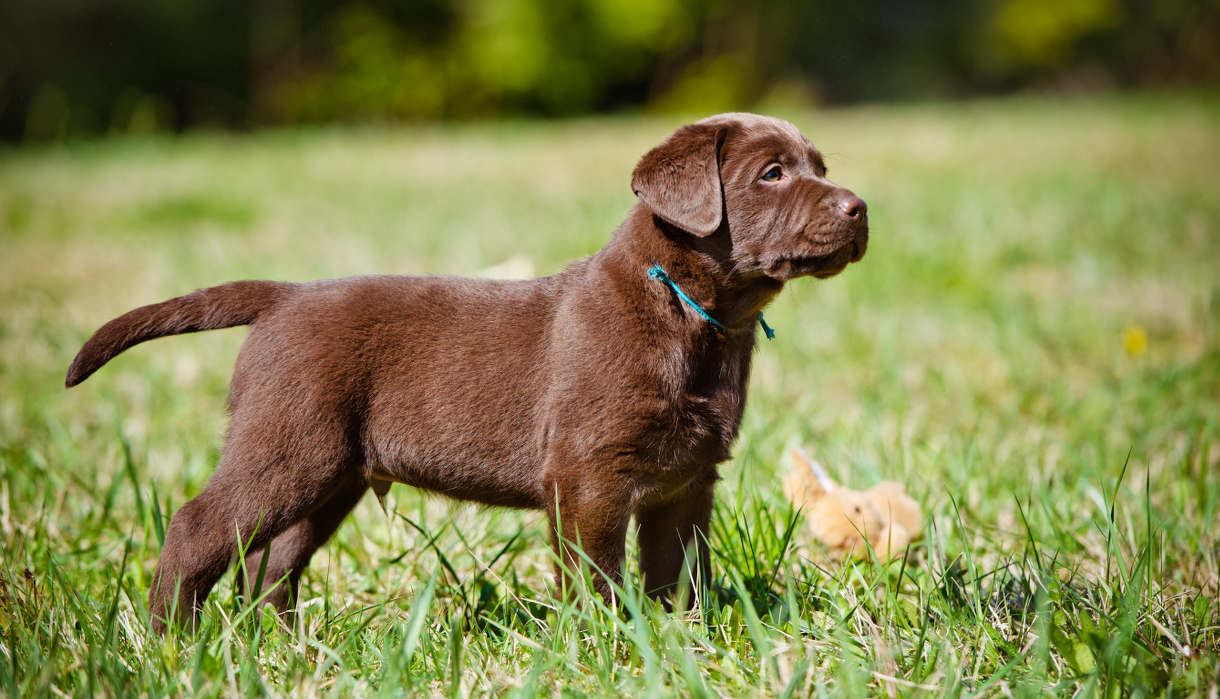
Chocolate Labrador puppies are ready to go to their permanent homes at around eight weeks old. If someone wants to sell you a puppy much younger than that, alarm bells should be ringing. You also need to make sure you buy your puppy from the right place.
This means choosing the right breeder. And avoiding puppy mills and pet stores. If you want a puppy for hunting, you need to go to a breeder that specialises in field-bred dogs. If you want to get involved in the world of showing, go to a breeder that breeds Labradors for the show ring. It is possible to train a show dog for work, though he or she is unlikely to get far in high level competitions. But it is not normally possible to succeed in the show ring with a field bred dog. Their body shape and structure is too different. Keep this in mind.
Chocolate Labrador Puppy Health
Labradors of all colors suffer from inherited disorders. Do make sure your puppy is from health tested parents. Their parents should have good hip scores, good elbow scores, clear eye tests and be PRA clear too.
If your puppy’s parents are in good health, you increase the odds for your puppy.
Are Chocolate Labs Less Healthy?
In 2018 a study hit the headlines hard, and had a lot of chocolate Lab owners in a panic. Their research suggested that there is a link between Lab color and not just health, but lifespan too. Over 33,000 Labs were studied, with 23.8% of them chocolate. Giving a good sample size.
Chocolate Labs in the study were more likely to have dermatitis, which matches with some anecdotal reports from owners of silver Labs with skin problems.
Ear problems are also more common, and this is in fact something Rachael suffered with. Gastrointestinal issues were more common with chocolate Labradors too.
Chocolate Labradors live on average for just 10.7 years, where yellow and black Labs come out at 12.1 years. Interestingly, they were least likely to have degenerative joint disease or dental problems.
Avoiding Health Problems in Chocolate Labs
Health testing is important for any puppy buyer. But it is also important to look at the coefficient of inbreeding. Chocolate Labs get their color from a recessive gene. This means that to ensure you have a litter of chocolate puppies you need to breed from two chocolate parents. This limits your options further than the average breeder who isn’t interested in the color of their puppies. Reducing gene pools will tend to increase health problems.
Finding a puppy with a very low coefficient of inbreeding will help you to avoid some of these problems. In addition to health testing, it would also be sensible to avoid a chocolate Lab puppy with parents that have a history of ear or skin problems.
You can find out more about health issues in Labradors in this article: Health screening for Labrador Diseases. And there is lots of information on finding a good breeder here: Labrador breeders – how to find a good one

Raising your puppy
Raising a puppy can be challenging. My top tips are to take your time, be patient. And don’t use force. Your first tasks are to get your puppy socialized, and clean and dry in the house. Here are some guides that will help you:
Early training starts with games and lots of treats.
Training and Exercising your Chocolate Labrador
My advice for training your chocolate Labrador is to follow a good positive reinforcement training program. Make sure you exercise your dog’s mind as well as their body. Even if you never intend to take them hunting, every Lab needs a job to do, this can be as simple as finding toys and carrying out simple retrieves.
 (paid link)
Training is important but its also fun. If your dog is from show lines, they too will need training and plenty of exercise, but they may also need plenty of play. Toys and games, and other dogs to interact with.
Training my Chocolate Lab
Even as an old dog, Rachael still loved to play with other dogs and with people. She was hugely enthusiastic about meeting people (and dogs) and prone to be a little over-friendly.

I therefore had to spend a bit more time ‘proofing’ basic obedience than I would with one of my yellow or black American Labs. And I had to make a special effort to ensure that she is not allowed to interact with visitors until she was sitting calmly. You may find you have to do the same with your dog.
On the plus side, I had to spend less time socializing Rachael than I would have with a field bred lab. As she took everything in her stride.
Caring for an old Chocolate Lab
Elderly chocolate Labradors are particularly beautiful, with their greying muzzles and kind eyes. As the years pass by, we leave behind one set of challenges and they are replaced by new ones. Failing eyesight, stiff joints, and declining hearing. However, these senior years can still be happy and fun filled for many dogs, especially if you keep your dog slim.
If your chocolate friend is heavily built as many chocolates are, you need to be extra careful to keep an eye on his weight as he ages. If your dog has taken up snoring loudly, that can be a clue that they are piling on too many pounds. More weight means more stress and strain on joints, this can aggravate problems like arthritis.
Keep walking your senior dog for as long as they are enjoying their daily exercise. Of course, you will want to make your old friend as comfortable as you can, so go ahead and indulge them with cosy blankets, a nice orthopaedic mattress or a special place on your sofa.
I’d love to hear about your own chocolate Lab, so do drop your story in the comments box below. Tell us what is so special about your chocolate Labrador and why you think they are the best.



Free Labrador Updates!
Get my training tips, news, reviews, and the latest from The Labrador Site delivered to your inbox
My chocolate lab is out of proportion. He stands at 37 inches tall at the withers and weighs 113 lbs. He seems well proportioned, and given the rib pronouncement test he isnt overweight. Just LARGE! Is this some kind of throwback to something more ancient, or just kind of a freak? His very broad back is noticeable as well as his very deep chest. He has normal belly tuck, and eats 4 cups of food a day with an occasional carrot or frozen green beans for a more bulky meal without over feeding. Should i be concerned with his health other than the usual damage weight can do to his joints? Anyway, just wondering if I have the AKC breed that is attached to him.
I would like to agree with the Chocolate being more sickly, my Male “Churro” has had ear, groin and arm pit issues his whole life, where as my Black, Yellow males, and the Chocolate Grandma have never had health issues, although I did have a Yellow Female who died from cancer at 7 years old. I have had Labs since 1987 and as many as 5 at one time, im a “Lab Freak” I love it and especially them… I did do a test for allergies and found some food issues that I am working on for Churro, he is actually getting over his life time issues ( 3 1/2 years) at about 90% i will continue as it is to be getting better week after week.
I have had 3 chocolate labs, 2 male and 1 female. Sweet tempered, stable and adorable dogs. Trained them, never any trouble in interaction with people or other dogs. No 1 reached 12.5 years, no 2 passed 6 wks before his 16th birthday (!) and no 3 we lost at 11.5 years old. Only no 3 had intestinal problems in his first year, he grew over it, never any trouble later. No 3 had many more ear-problems than the first two. We are up for no 4 soon, they are the best!
I just rescued a chocolate lab about 18 months old with infection in one eye and both ears! I got him a week ago today I need just had his first visit.
I just turned 87. I’m doing very well for my age and look forward to enjoying my dog.
We are on our third chocolate lab at the moment, all 3 have been bitches and all 3 have been very loved. No 1 was molly she was a 2 1/2 yr old rescue we had her till she was 14+ then came millie she was purchased from a farmer in Wales she did have a lot of problems with her ears but we had her for 12 1/2 yrs before we lost her now we have tilly she was bought from a private home and she’s now 2 1/2 yrs old she’s part labrador and part cow always carrying half a tree trunk in her mouth or grazing on grass. I can honestly say chocolate is our colour and we wouldn’t have any other.
What lovely girls you’ve been blessed with ❤️